
Micronutrients: Magnesium, Zinc and Selenium
8 min read
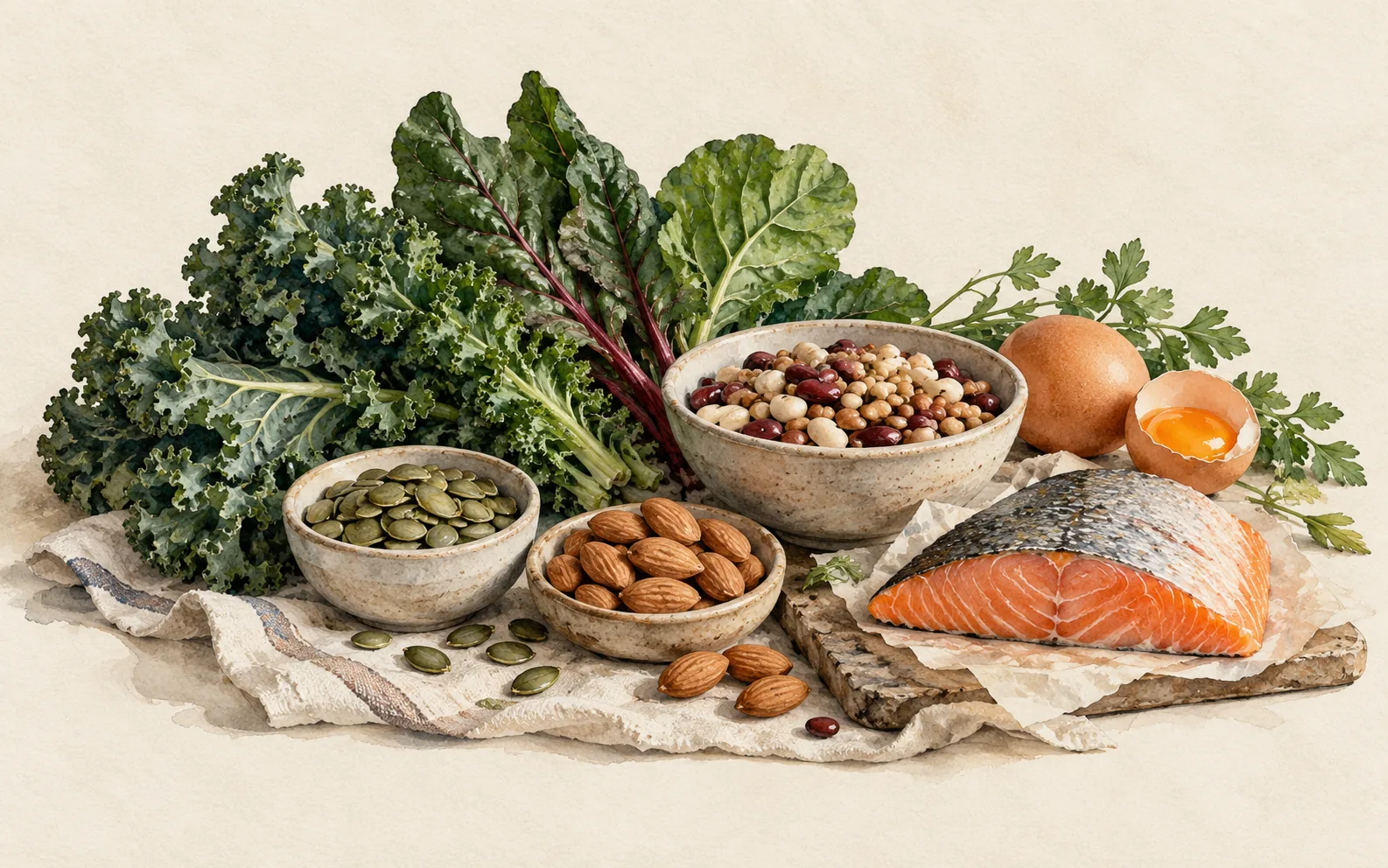
Micronutrients: Small Amounts, Important Functions
Magnesium, zinc, and selenium are essential minerals and trace elements. The body needs them in relatively small amounts, yet without them numerous metabolic processes cannot function properly. In Switzerland, the adult population does not reach the recommended magnesium intake on average (exception: men aged 35 to 49), and men’s zinc intake is on average 12% below the recommendation. Food supplements are not included in these figures (FSVO, Schweizer Ernährungsbulletin 2021).
Magnesium: The Underestimated Mineral
Magnesium is involved in over 300 enzymatic reactions in the body. Magnesium contributes to normal energy-yielding metabolism. Magnesium contributes to normal muscle function. Magnesium contributes to normal functioning of the nervous system. Magnesium contributes to normal protein synthesis. Magnesium contributes to a reduction of tiredness and fatigue (authorised health claims, Regulation (EU) No 432/2012).
Ensuring adequate intake through diet is an important goal.
Bioavailability of Different Magnesium Forms
Magnesium absorption depends on the dose, on the food matrix, and on enhancing and inhibiting factors (Schuchardt & Hahn 2017).
Whether organic magnesium compounds are absorbed better than inorganic ones has not been clearly established: some studies found slightly higher absorption of organic salts, others did not (Schuchardt & Hahn 2017). In studies with healthy people, magnesium oxide was absorbed less well than magnesium citrate (Lindberg et al. 1990; Walker et al. 2003); in another study, only 4% of the magnesium from magnesium oxide was absorbed (Firoz & Graber 2001).
Magnesium-Rich Foods
Good natural sources include pumpkin seeds (approx. 520 mg/100 g, Swiss Food Composition Database), sunflower seeds, almonds, cashews, amaranth, and cacao. Dark leafy greens like spinach also provide notable amounts, as magnesium sits at the centre of the chlorophyll molecule.
Zinc: Immune System, DNA Synthesis, and Cell Division
Zinc is involved in over 300 enzymes and in over 1,000 transcription factors. Zinc contributes to the normal function of the immune system. Zinc contributes to normal DNA synthesis. Zinc has a role in the process of cell division. Zinc contributes to the maintenance of normal testosterone levels in the blood (authorised health claims, Regulation (EU) No 432/2012). Wessels et al. (2017) describe in a review how zinc ions regulate signalling pathways in immune cells.
The body does not have a large zinc reservoir. Therefore, regular dietary intake is necessary. The recommended daily amount is 7-10 mg for women and 11-16 mg for men (DACH reference values). The highest value (men 16 mg, women 10 mg) applies to a diet high in phytic acid, i.e. with plenty of unsprouted or unfermented whole grain products and legumes and predominantly plant-based protein sources.
The Problem with Phytic Acid
Phytic acid is found in legumes, whole grains, nuts, and seeds. It binds zinc in the digestive tract and reduces its absorption. Simple preparation methods can lower the phytic acid content:
- Soaking: Soaking can lower the phytate content. The extent depends on the food and on the soaking time.
- Sprouting: Sprouting legumes and grains activates the enzyme phytase, which breaks down phytic acid.
- Fermenting: Phytate can be broken down during sourdough fermentation.
Zinc and Testosterone
Zinc contributes to the maintenance of normal testosterone levels in the blood (authorised health claim, Regulation (EU) No 432/2012). Prasad et al. (1996) examined the relationship between the zinc content of blood cells and serum testosterone in 40 healthy men aged 20 to 80 years and found a positive correlation. In men with adequate zinc status, a zinc-containing supplement (ZMA) did not change testosterone levels in a study with 14 participants (Koehler et al. 2009).
Selenium: Thyroid Function and Protection of Cells from Oxidative Stress
Selenium is an essential trace element that the body needs in very small amounts (recommended: 60-70 µg/day). It is a component of the 25 selenoproteins known in humans, including the glutathione peroxidase family and thioredoxin reductase.
Selenium contributes to the normal thyroid function. Selenium contributes to the normal function of the immune system. Selenium contributes to the protection of cells from oxidative stress (authorised health claims, Regulation (EU) No 432/2012). Selenium is incorporated into selenoproteins, which are involved, among other things, in the metabolism of thyroid hormones (EFSA 2017). The thyroid gland has the highest selenium content per gram of tissue in the entire body.
Brazil Nuts: The Selenium Champion
Brazil nuts contain particularly high amounts of selenium, but the content varies widely. Thomson et al. (2008) demonstrated that consuming two Brazil nuts per day improved selenium status as effectively as a supplement containing 100 µg of selenomethionine. The two Brazil nuts provided an average of 53 µg of selenium per day (possible range 20 to 84 µg). The German Nutrition Society (DGE) advises eating no more than two Brazil nuts per day.
Other selenium sources are animal foods such as meat, fish, and eggs. The selenium content of plant-based foods depends heavily on the selenium content of the soil and therefore varies widely.
Interactions Between Minerals
Minerals and trace elements influence each other during absorption. Anyone who supplements should be aware of these interactions.
Zinc and copper: High zinc intakes over extended periods can inhibit copper absorption. For adults, the tolerable upper intake level is 25 mg of zinc per day from all sources (SCF 2002, EFSA).
Calcium and zinc: Larger doses of calcium can reduce zinc absorption (SCF 2002).
Selenium and vitamin E: Selenium contributes to the protection of cells from oxidative stress. Vitamin E contributes to the protection of cells from oxidative stress (authorised health claims, Regulation (EU) No 432/2012).
Comparative Overview
| Magnesium | Zinc | Selenium | |
|---|---|---|---|
| Reference values for daily intake | 300-350 mg | 7-16 mg | 60-70 µg |
| Best sources | Pumpkin seeds, cacao, almonds | Oysters, beef, pumpkin seeds | Brazil nuts, fish, eggs |
| Plant source (example, per 100 g) | Pumpkin seeds (approx. 520 mg) | Pumpkin seeds (approx. 5 mg) | Brazil nuts (content varies widely) |
| Groups with lower intake | Women aged 65 and over | Men | Vegan diet |
When Is Supplementation Worthwhile?
The priority should always be a varied, nutrient-rich diet. In certain situations, however, targeted supplementation can be beneficial:
- Check supply status: A blood test from a healthcare provider clarifies the situation. Serum magnesium alone is not very informative, as only around 0.3% of total body magnesium is found in the serum.
- Increased demand: Pregnancy and breastfeeding can increase the requirement for zinc, and breastfeeding also the requirement for selenium.
- Impaired absorption: Certain medications or high alcohol consumption can affect nutrient absorption. Medical advice is recommended.
- Vegan diet: Zinc intake in particular should be consciously planned with a purely plant-based diet. Prepare phytic acid-rich foods through soaking or sprouting.
Conclusion
Magnesium, zinc, and selenium are indispensable for a wide range of bodily functions. A conscious food selection can ensure adequate supply in most cases. Pumpkin seeds, Brazil nuts, cacao, and dark leafy greens are particularly valuable sources. Those who supplement should choose highly bioavailable forms and consider interactions between minerals. A blood panel can determine whether supplementation is actually necessary.
Sources:
- Wäfler M, Zuberbuehler CA (2021). Wie gut ist die Bevölkerung der Schweiz mit Mikronährstoffen versorgt? Schweizer Ernährungsbulletin 2021, Federal Food Safety and Veterinary Office FSVO (in German). blv.admin.ch
- FDHA Ordinance on Food Information (LIV, SR 817.022.16), Annex 14, version of 1 July 2025 (in German). fedlex.admin.ch
- Schuchardt JP, Hahn A (2017). Intestinal absorption and factors influencing bioavailability of magnesium, an update. Current Nutrition & Food Science, 13(4), 260-278. DOI: 10.2174/1573401313666170427162740
- Lindberg JS, Zobitz MM, Poindexter JR, Pak CY (1990). Magnesium bioavailability from magnesium citrate and magnesium oxide. Journal of the American College of Nutrition, 9(1), 48-55. DOI: 10.1080/07315724.1990.10720349
- Walker AF, Marakis G, Christie S, Byng M (2003). Mg citrate found more bioavailable than other Mg preparations in a randomised, double-blind study. Magnesium Research, 16(3), 183-191.
- Firoz M, Graber M (2001). Bioavailability of US commercial magnesium preparations. Magnesium Research, 14(4), 257-262.
- Federal Food Safety and Veterinary Office FSVO: Swiss Food Composition Database, version 7.1. All data refer to 100 g edible portion. naehrwertdaten.ch
- Prasad AS (2013). Discovery of human zinc deficiency: its impact on human health and disease. Advances in Nutrition, 4(2), 176-190. DOI: 10.3945/an.112.003210
- Wessels I, Maywald M, Rink L (2017). Zinc as a Gatekeeper of Immune Function. Nutrients, 9(12), 1286. DOI: 10.3390/nu9121286
- German Nutrition Society (DGE): Reference values for nutrient intake, zinc (derived in 2019; in German). dge.de
- Prasad AS, Mantzoros CS, Beck FW, Hess JW, Brewer GJ (1996). Zinc status and serum testosterone levels of healthy adults. Nutrition, 12(5), 344-348. DOI: 10.1016/S0899-9007(96)80058-X
- Koehler K, Parr MK, Geyer H, Mester J, Schänzer W (2009). Serum testosterone and urinary excretion of steroid hormone metabolites after administration of a high-dose zinc supplement. European Journal of Clinical Nutrition, 63(1), 65-70. DOI: 10.1038/sj.ejcn.1602899
- German Nutrition Society (DGE): Reference values for nutrient intake, selenium (derived in 2015; in German). dge.de
- EFSA (2017). Dietary Reference Values for nutrients, Summary report. EFSA supporting publication, 2017:e15121. DOI: 10.2903/sp.efsa.2017.e15121
- Thomson CD, Chisholm A, McLachlan SK, Campbell JM (2008). Brazil nuts: an effective way to improve selenium status. American Journal of Clinical Nutrition, 87(2), 379-384. DOI: 10.1093/ajcn/87.2.379
- EFSA (2006). Tolerable Upper Intake Levels for Vitamins and Minerals, including the SCF opinions on magnesium (26 September 2001, pp. 107-116) and zinc (5 March 2002, pp. 191-197). efsa.europa.eu
- German Nutrition Society (DGE): Reference values for nutrient intake, magnesium (derived in 2021; in German). dge.de
Related articles
-
Black maca: why the rare root from Junín stands out
Discover maca’s history in Junín, why black roots are uncommon, how they differ from maca mix and how to use both in the kitchen.
-
From cacao nib to drink: what shapes cacao flavour
Cacao from the Dominican Republic, roasted nibs, no alkalisation and two simple ways to prepare the powder.
-
Calculating Calorie Needs: BMR, TDEE & Macros
How to calculate your calorie needs: Mifflin-St Jeor formula, activity factor and macronutrient distribution simply explained.
Disclaimer
The information on this page is provided for general informational and educational purposes only. It does not constitute medical advice, diagnosis or treatment recommendations and is not a substitute for professional medical consultation. Dietary supplements are not a substitute for a balanced and varied diet and a healthy lifestyle. If you have health concerns, pre-existing conditions, are pregnant, breastfeeding or taking medication, please consult a physician before use. Bunaroba AG assumes no liability for decisions made based on this content. Despite careful research, errors cannot be excluded.
Editorial responsibility for this article: Roger Giese. How we use AI tools is set out under Use of AI.