
Omega-3 & Omega-6: Sources and Recommended Amounts
6 min read
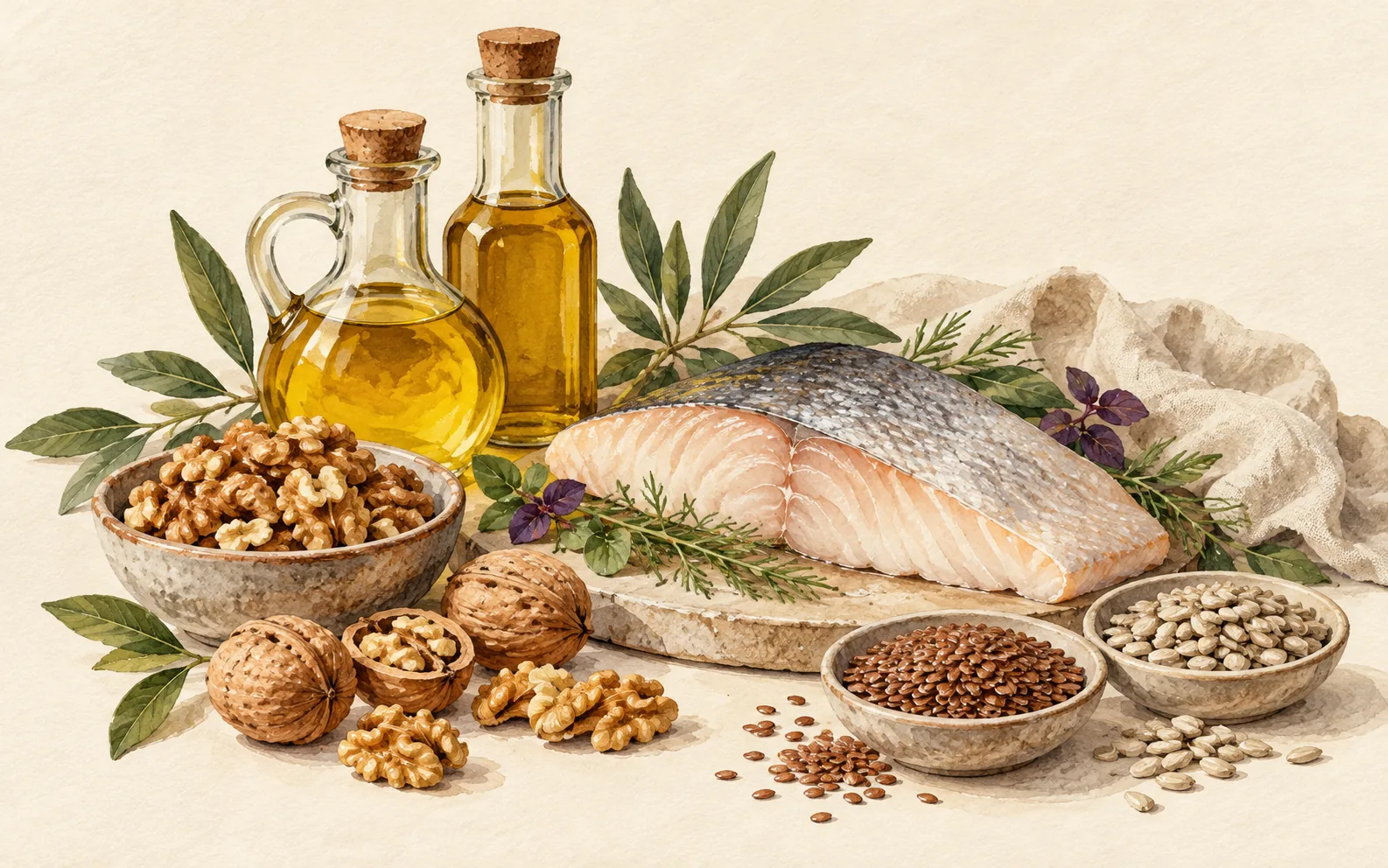
The Imbalance in the Western Diet
Linoleic acid (omega-6) and alpha-linolenic acid (omega-3) are essential fatty acids. The body cannot produce them on its own and depends on dietary intake. Both serve important functions. For both groups of fatty acids, authorities issue recommendations on absolute intake amounts.
Simopoulos (2002) writes that several sources of information suggest that human beings evolved on a diet with an omega-6 to omega-3 ratio of approximately 1:1. For Western diets, she gives a ratio of 15:1 to 16.7:1. The Swiss Federal Commission for Nutrition recommends 2.5 to 9% of daily energy requirements for omega-6 fatty acids and 0.5 to 2% for omega-3 fatty acids.
What Authorities Recommend
EFSA specifies an adequate intake of 4% of energy for linoleic acid (omega-6) and 0.5% of energy for alpha-linolenic acid (omega-3), and 250 mg per day for EPA and DHA combined. It does not set an upper limit for omega-6 fatty acids or a ratio between omega-3 and omega-6.
Omega-3 and omega-6 are precursors of different groups of signalling molecules (eicosanoids) in the body. The respective eicosanoids serve different biological roles. Both fatty acid families are essential; the body needs them for numerous metabolic processes.
Omega-3: The Three Key Forms
| Form | Found in | Note |
|---|---|---|
| ALA (alpha-linolenic acid) | Flaxseed oil, chia seeds, walnuts, hemp oil | Plant-based precursor |
| EPA (eicosapentaenoic acid) | Fatty fish, algae oil | Precursor of certain eicosanoids |
| DHA (docosahexaenoic acid) | Fatty fish, algae oil | Long-chain omega-3 fatty acid |
The ALA Conversion
The body can convert ALA into EPA and DHA. However, the conversion rate is limited. Studies show that in adult men only about 8% of ALA is converted to EPA and less than 0.1% to DHA. In women, a greater proportion is converted to DHA (9%) (Williams & Burdge, 2006). In women, the proportion converted to longer-chain omega-3 fatty acids is higher, possibly due to the influence of oestrogen (Burdge & Calder, 2005).
This means that plant-based omega-3 sources are valuable but may not be sufficient on their own to meet EPA and DHA requirements. Algae oil can serve as a plant-based alternative to fish oil.
Fatty Acids in Oils
| Oil | Linoleic acid (omega-6), g per 100 g | Alpha-linolenic acid (omega-3), g per 100 g |
|---|---|---|
| Flaxseed oil | 14.78 | 49.82 |
| Hemp oil | 52.58 | 18.75 |
| Rapeseed/canola oil | 19.66 | 8.54 |
| Olive oil | 6.52 | 0.65 |
| Sunflower oil | 56.3 | 0.05 |
| Corn oil | 55.23 | 1.01 |
| Soybean oil | 53.37 | 6.89 |
Source: Swiss Food Composition Database (FSVO), version 7.1.
Plant-Based Omega-3 Sources
Those looking to increase their omega-3 intake can turn to these ALA-rich foods:
- Flaxseed oil and flaxseeds: Flaxseed oil contains approx. 50 g, flaxseeds approx. 21 g of alpha-linolenic acid per 100 g
- Chia seeds: Approx. 19 g of alpha-linolenic acid per 100 g, also high in fibre
- Hemp oil: Approx. 53 g of linoleic acid (omega-6) and approx. 19 g of alpha-linolenic acid (omega-3) per 100 g
- Walnuts: Approx. 7.5 g of alpha-linolenic acid per 100 g, easy to incorporate as a snack
- Rapeseed/canola oil: A practical everyday alternative for cooking
Practical Tips
Choose Your Oils Wisely
The Swiss dietary recommendations specify 2 tablespoons of vegetable oil daily, including at least 1 tablespoon of rapeseed oil, and 1 small handful of unsalted nuts or seeds (15 to 30 g) daily, for example walnuts or flaxseeds.
Incorporate Seeds and Nuts
One tablespoon of whole flaxseeds (10.3 g) provides roughly 2.3 g of alpha-linolenic acid, one tablespoon of ground flaxseeds (7 g) roughly 1.6 g. Walnuts as a snack or in salads are a simple addition.
Reduce Processed Foods
Ready meals, crisps, pastries and fast food often contain large amounts of sunflower oil or other omega-6-rich oils. Eating less of these improves the ratio automatically.
Get EPA and DHA Directly
Due to the limited ALA conversion, direct intake of EPA and DHA can be useful. Two options:
- Fatty fish: Salmon, mackerel, sardines (fish once or twice a week, especially fatty sea fish, 100 to 240 g per week)
- Algae oil: A plant-based alternative that provides EPA and DHA directly. Particularly suitable for vegetarian or vegan diets.
What Does the Research Say?
DHA contributes to maintenance of normal brain function. DHA contributes to the maintenance of normal vision. The beneficial effect is obtained with a daily intake of 250 mg of DHA. EPA and DHA contribute to the normal function of the heart. The beneficial effect is obtained with a daily intake of 250 mg of EPA and DHA. (authorised health claims)
Conclusion
The Swiss Federal Commission for Nutrition recommends amounts rather than a ratio: 2.5 to 9% of daily energy requirements as omega-6 fatty acids and 0.5 to 2% as omega-3 fatty acids, plus fish once or twice a week, especially fatty sea fish. In humans, the conversion of alpha-linolenic acid into EPA and DHA is quantitatively low. The goal is not to avoid omega-6. Both fatty acids are essential.
Sources:
- Simopoulos AP (2002). The importance of the ratio of omega-6/omega-3 essential fatty acids. Biomedicine & Pharmacotherapy, 56(8), 365-379. DOI: 10.1016/s0753-3322(02)00253-6
- Burdge GC, Calder PC (2005). Conversion of alpha-linolenic acid to longer-chain polyunsaturated fatty acids in human adults. Reproduction Nutrition Development, 45(5), 581-597. DOI: 10.1051/rnd:2005047
- Williams CM, Burdge G (2006). Long-chain n-3 PUFA: plant v. marine sources. Proceedings of the Nutrition Society, 65(1), 42-50. DOI: 10.1079/pns2005473
- EFSA (European Food Safety Authority) (2017). Dietary Reference Values for nutrients. Summary report. EFSA Supporting Publications, 14(12), e15121. DOI: 10.2903/sp.efsa.2017.e15121
- Swiss Federal Commission for Nutrition EEK (2013). Fette in der Ernährung. Aktualisierte Empfehlungen der Eidgenössischen Ernährungskommission. Supplementum zum Expertenbericht “Fette in der Ernährung”, adopted on 30 September 2012. Federal Office of Public Health, Zurich, January 2013 (in German).
- Federal Food Safety and Veterinary Office FSVO. Swiss Food Composition Database, version 7.1. naehrwertdaten.ch.
- Federal Food Safety and Veterinary Office FSVO. Swiss dietary recommendations for adults (18-65 years).
- Ordinance of the FDHA on Food Information (LIV), SR 817.022.16, Annex 14, version of 1 July 2025. Fedlex.
- Swiss Society for Nutrition SGE. FAQ: “Was sind Omega-3-Fettsäuren und worin sind sie enthalten?” (in German).
Related articles
-
Black maca: why the rare root from Junín stands out
Discover maca’s history in Junín, why black roots are uncommon, how they differ from maca mix and how to use both in the kitchen.
-
From cacao nib to drink: what shapes cacao flavour
Cacao from the Dominican Republic, roasted nibs, no alkalisation and two simple ways to prepare the powder.
-
Calculating Calorie Needs: BMR, TDEE & Macros
How to calculate your calorie needs: Mifflin-St Jeor formula, activity factor and macronutrient distribution simply explained.
Disclaimer
The information on this page is provided for general informational and educational purposes only. It does not constitute medical advice, diagnosis or treatment recommendations and is not a substitute for professional medical consultation. Dietary supplements are not a substitute for a balanced and varied diet and a healthy lifestyle. If you have health concerns, pre-existing conditions, are pregnant, breastfeeding or taking medication, please consult a physician before use. Bunaroba AG assumes no liability for decisions made based on this content. Despite careful research, errors cannot be excluded.
Editorial responsibility for this article: Roger Giese. How we use AI tools is set out under Use of AI.