
The Simple Principles of Nutrition
8 min read
What Matters When Choosing a Diet?
When choosing a diet, what matters most is whether it can be sustained in everyday life. The fitness industry thrives on complicated diets and trends. Sustainable results come from simple principles that can be maintained long-term.
A meta-analysis by Johnston et al. (2014) covering 48 randomised trials and 7,286 adults with a BMI of 25 or above compared well-known diets and found only small differences in weight loss between the individual diets. The authors conclude from this that the diet a person can stick with should be recommended.
What Are Macronutrients and Why Do They Matter?
Macronutrients are protein, carbohydrates, and fats. They provide energy and serve as building blocks for muscles, hormones, and cell structures. The right balance affects satiety and body composition.
Protein
Protein is the building block for muscles, enzymes, and hormones. For most physically active people, the International Society of Sports Nutrition considers 1.4-2.0g of protein per kilogram of body weight per day sufficient (Jäger et al., 2017). More on this in the article How Much Protein You Really Need. You can calculate your individual requirement with the protein calculator.
High-quality protein sources:
- Legumes (lentils, chickpeas, beans)
- Tofu, tempeh, seitan
- Nuts and seeds
- High-quality protein powder
- Eggs and dairy products (if consumed)
Carbohydrates
Carbohydrates are the primary fuel for intense physical activity. Glycogen stores in muscles and the liver provide quick energy.
The WHO recommends that adults consume at least 25g of fibre per day from natural sources (WHO, 2023). The DGE gives a guideline value of at least 30g per day.
Prefer:
- Whole grains
- Oats
- Potatoes and sweet potatoes
- Legumes
- Fruits and vegetables
Fats
Fats are essential for hormone production, vitamin absorption, and cell membranes. For adults, EFSA gives a reference intake range of 20-35% of energy from fat (EFSA, 2010), and the DGE a guideline value of 30-35%.
Essential fatty acids: The body cannot produce linoleic acid (omega-6) and alpha-linolenic acid (omega-3) itself. For adults, EFSA sets an adequate intake of 4% of energy as linoleic acid and 0.5% of energy as alpha-linolenic acid (EFSA, 2010).
Hemp oil contains linoleic acid (omega-6) and alpha-linolenic acid (omega-3) in a ratio of about 3:1 (Chen et al., 2010) as well as gamma-linolenic acid (GLA) (Da Porto et al., 2015).
Good fat sources:
- Hemp oil and hemp seeds (omega-3 and omega-6)
- Olive oil (rich in monounsaturated fatty acids)
- Nuts and seeds (especially walnuts, flaxseeds, chia seeds)
- Avocados
- Fatty fish (salmon, mackerel, sardines)
How Does Calorie Balance Work?
Calorie balance is the primary factor in weight change: consuming fewer calories than you burn leads to weight loss, and consuming more leads to weight gain. Regardless of the diet type, the principle of energy balance applies:
- Losing weight: Calorie deficit
- Gaining weight: Calorie surplus
- Maintaining weight: Calorie balance
This doesn’t mean that “a calorie is just a calorie” - the composition of your diet affects satiety, hormonal status, and body composition. But energy balance remains the primary factor in weight change.
How Do You Put Healthy Eating into Practice?
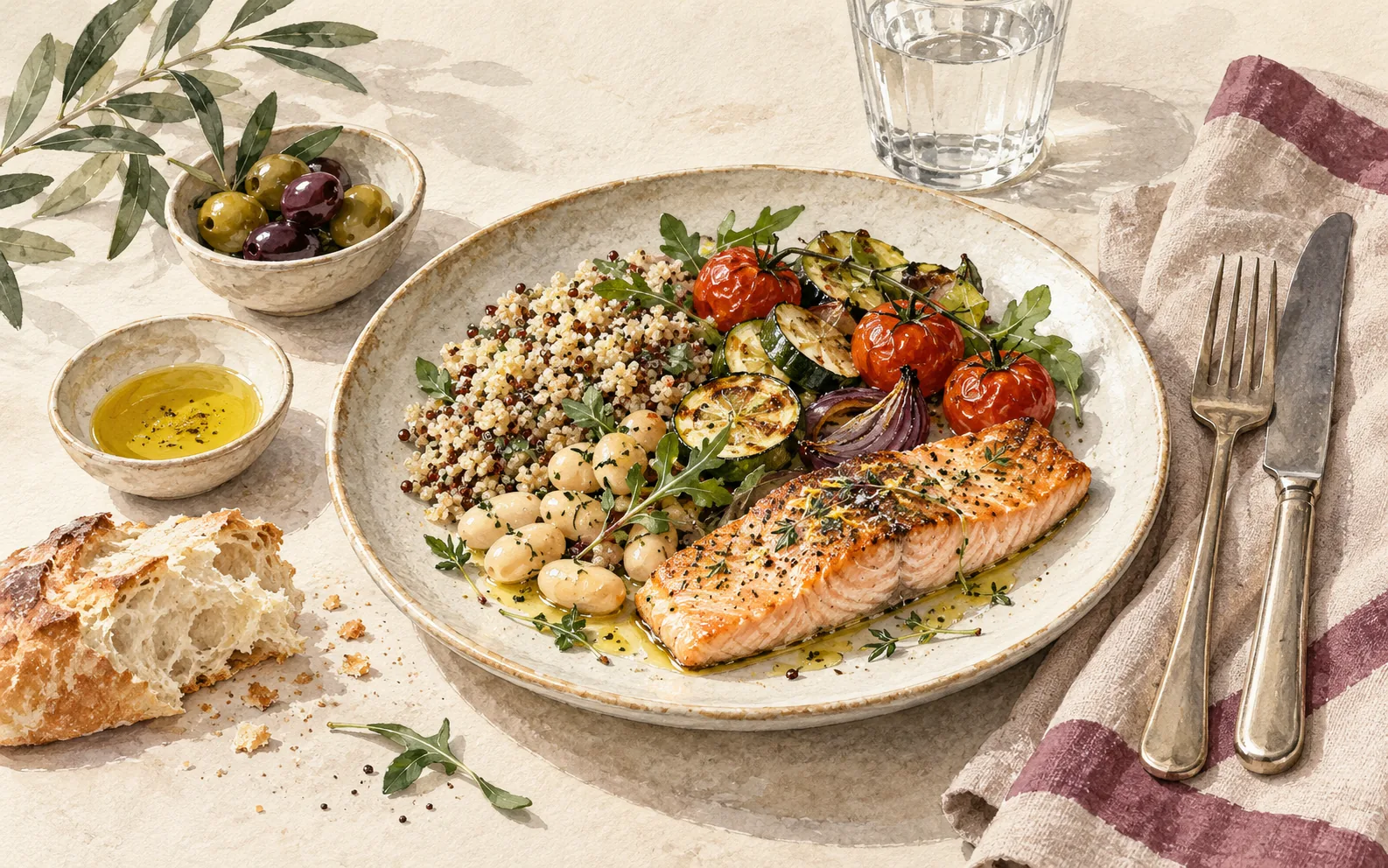
The simplest approach is the balanced plate from the Swiss dietary recommendations: two fifths vegetables and fruit, two fifths carbohydrates and one fifth protein. Add adequate hydration and a sustainable meal frequency.
The Balanced Plate
A simple visual approach for balanced meals:
- 2/5 of the plate: Vegetables and fruit
- 2/5 of the plate: Carbohydrates (potatoes, grain products such as pasta, rice and bread)
- 1/5 of the plate: Protein (legumes, tofu, eggs, meat, fish, dairy products)
Meal Frequency
A meta-analysis by Schoenfeld et al. (2015) of 15 studies initially found an association between more frequent meals and lower fat mass. In the sensitivity analysis, this finding was attributable to a single study, and the authors urge caution in interpreting it.
More important: Choose a frequency that fits your daily routine and that you can stick with.
The International Society of Sports Nutrition recommends spreading protein intake across the day, roughly every 3-4 hours (Jäger et al., 2017).
Hydration
Endurance performance can decline once fluid loss reaches 2% (Cheuvront & Kenefick, 2014).
Guideline: 1-2 litres of unsweetened drinks per day (FSVO). More during exercise and in hot conditions.
Micronutrients
Vitamins and minerals are essential for countless bodily functions. A varied diet rich in vegetables, fruits, and whole grains generally covers requirements.
What to pay particular attention to in Switzerland (FSVO):
- Vitamin D: The FSVO recommends vitamin D as a dietary supplement for infants and children up to their third birthday and for people aged 60 and over (FSVO)
- Iron: According to the menuCH nutrition survey, women consume less iron than men (FSVO)
- Vitamin B12: Must be supplemented on a vegan diet
Processed Foods
The Swiss dietary recommendations advise favouring unprocessed and minimally processed foods wherever possible (SGE and FSVO, 2024).
This doesn’t mean that occasional consumption is problematic. But the majority of the diet should consist of minimally processed foods.
Building Sustainable Habits
Small Steps
Small, concrete steps are often easier to implement in everyday life than a radical overhaul. Building one new habit after another is one possible approach.
The 80/20 Rule
If 80% of your diet consists of nutrient-dense, unprocessed foods, there’s room for 20% flexibility without guilt.
Meal Prep
Planning meals in advance means having suitable options to hand in everyday life. In a cross-sectional study of over 40,000 adults in France, meal planning was associated with higher diet quality and greater food variety (Ducrot et al., 2017).
No Strict Prohibitions
Restrictive diets are difficult to maintain long-term. Incorporate your favourite foods in moderation rather than eliminating them completely.
Conclusion
Healthy eating doesn’t have to be complicated: primarily unprocessed foods, sufficient protein, plenty of vegetables and fibre, enough water. The best diet is the one you can sustain long-term.
Further Reading
- Calculating Calorie Needs: BMR, TDEE & Macros
- Calorie Calculator
- How Much Protein You Really Need
- Dietary Supplements: What the Science Says
- Organic Hemp Oil
- Organic Hemp Seeds
- Organic Chia Seeds
Sources:
- Johnston BC, Kanters S, Bandayrel K, Wu P, Naji F, Siemieniuk RA et al. (2014). Comparison of weight loss among named diet programs in overweight and obese adults: a meta-analysis. JAMA, 312(9), 923-933. DOI: 10.1001/jama.2014.10397
- Jäger R, Kerksick CM, Campbell BI, Cribb PJ, Wells SD, Skwiat TM et al. (2017). International Society of Sports Nutrition Position Stand: protein and exercise. Journal of the International Society of Sports Nutrition, 14, 20. DOI: 10.1186/s12970-017-0177-8
- Schoenfeld BJ, Aragon AA, Krieger JW (2015). Effects of meal frequency on weight loss and body composition: a meta-analysis. Nutrition Reviews, 73(2), 69-82. DOI: 10.1093/nutrit/nuu017
- Cheuvront SN, Kenefick RW (2014). Dehydration: physiology, assessment, and performance effects. Comprehensive Physiology, 4(1), 257-285. DOI: 10.1002/cphy.c130017
- World Health Organization (2023). Carbohydrate intake for adults and children: WHO guideline. Geneva: World Health Organization. ISBN 978-92-4-007359-3
- Deutsche Gesellschaft für Ernährung (DGE). Reference values for nutrient intake: dietary fibre (in German). dge.de
- EFSA Panel on Dietetic Products, Nutrition and Allergies (NDA) (2010). Scientific Opinion on Dietary Reference Values for fats, including saturated fatty acids, polyunsaturated fatty acids, monounsaturated fatty acids, trans fatty acids, and cholesterol. EFSA Journal, 8(3), 1461. DOI: 10.2903/j.efsa.2010.1461
- EFSA (European Food Safety Authority) (2017). Dietary Reference Values for nutrients: Summary report. EFSA Supporting Publications, 14(12), e15121. DOI: 10.2903/sp.efsa.2017.e15121
- Federal Food Safety and Veterinary Office FSVO. Swiss dietary recommendations for adults (18-65 years) (in German). blv.admin.ch
- Federal Food Safety and Veterinary Office FSVO. Need for dietary supplements, only in certain life situations (in German). blv.admin.ch
- Federal Food Safety and Veterinary Office FSVO. menuCH, results of the study (in German). blv.admin.ch
- Swiss Society for Nutrition SGE, Federal Food Safety and Veterinary Office FSVO (2024). Swiss dietary recommendations for adults, short version (in German). Bern. sge-ssn.ch
- Chen T, He J, Zhang J, Zhang H, Qian P, Hao J, Li L (2010). Analytical characterization of hempseed (seed of Cannabis sativa L.) oil from eight regions in China. Journal of Dietary Supplements, 7(2), 117-129. DOI: 10.3109/19390211003781669
- Da Porto C, Decorti D, Natolino A (2015). Potential oil yield, fatty acid composition, and oxidation stability of the hempseed oil from four Cannabis sativa L. cultivars. Journal of Dietary Supplements, 12(1), 1-10. DOI: 10.3109/19390211.2014.887601
- Ducrot P, Méjean C, Aroumougame V, Ibanez G, Allès B, Kesse-Guyot E et al. (2017). Meal planning is associated with food variety, diet quality and body weight status in a large sample of French adults. International Journal of Behavioral Nutrition and Physical Activity, 14, 12. DOI: 10.1186/s12966-017-0461-7
Frequently Asked Questions
How much fibre do I need per day?
What is the best diet for weight loss?
How much water should I drink per day?
Related articles
-
Black maca: why the rare root from Junín stands out
Discover maca’s history in Junín, why black roots are uncommon, how they differ from maca mix and how to use both in the kitchen.
-
From cacao nib to drink: what shapes cacao flavour
Cacao from the Dominican Republic, roasted nibs, no alkalisation and two simple ways to prepare the powder.
-
Calculating Calorie Needs: BMR, TDEE & Macros
How to calculate your calorie needs: Mifflin-St Jeor formula, activity factor and macronutrient distribution simply explained.
Disclaimer
The information on this page is provided for general informational and educational purposes only. It does not constitute medical advice, diagnosis or treatment recommendations and is not a substitute for professional medical consultation. Dietary supplements are not a substitute for a balanced and varied diet and a healthy lifestyle. If you have health concerns, pre-existing conditions, are pregnant, breastfeeding or taking medication, please consult a physician before use. Bunaroba AG assumes no liability for decisions made based on this content. Despite careful research, errors cannot be excluded.
Editorial responsibility for this article: Roger Giese. How we use AI tools is set out under Use of AI.